
CORE 4 of 4
Sustainable Growth
The structure that sustains gains and enables scale. Systems scale. Heroes don't. Without a management operating system, philosophy fades, profit leaks, and cash traps build. The system runs the business so leaders can improve the business.
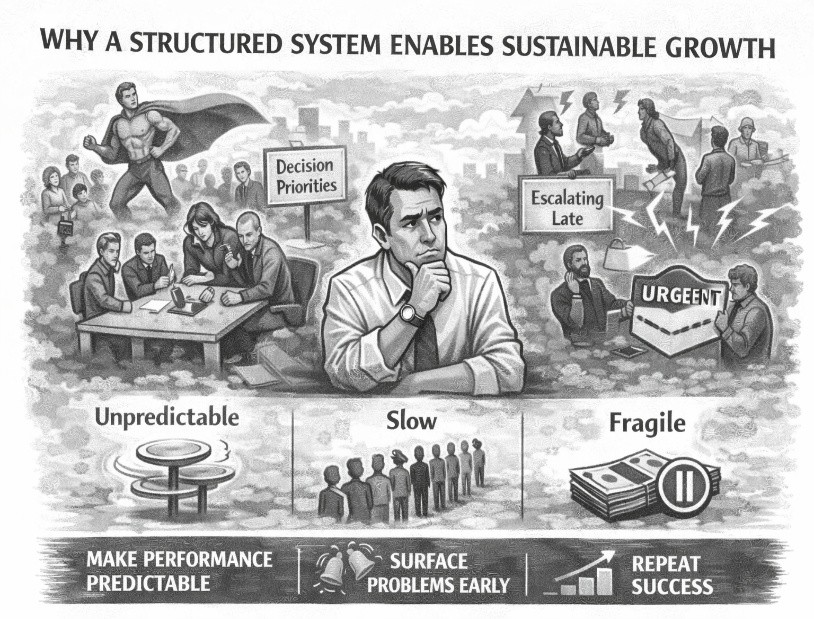
Sustainable Growth: Why Systems Come Last and Why Heroes Can’t Scale
Sustainable growth is the fourth discipline in The CORE 4 framework because sustainability requires structure. You can have brilliant philosophy, disciplined throughput management, and tight scheduling — but without systems to sustain them, you are dependent on heroes. And heroes burn out, heroes leave, and heroes cannot scale.
The management operating system is what makes the other three disciplines sustainable. It is the daily rhythm that surfaces problems early, connects frontline teams to business objectives, and ensures that improvement is continuous rather than occasional. Without it, philosophy fades into posters, profit leaks through unprotected constraints, and cash traps build up in unmanaged work-in-process.
This page explores why most organizations start with systems and fail, why sustainable growth requires the first three disciplines in place, and how the management operating system turns individual belief into organizational capability. The sequence builds forward: philosophy enables profit, profit enables cash, cash enables systems. And sustainability flows backward.
The Hero Trap
When Everything Runs on Heroes, Leaders Survive Each Day Instead of Improving It
The hero is not saving the business—the hero is preventing the business from becoming a business. When the hero takes a vacation, things slip. When the hero gets sick, fires break out. When the hero leaves, the knowledge walks out the door.
You cannot sell, scale, or sustain a business that depends on specific people instead of documented systems.
The most dangerous failure mode is subtle: everything works until it doesn't. The organization celebrates the hero's effort while ignoring that the heroics are a symptom of system failure. The system should handle variation. When it doesn't, people do—and people burn out.
When everything runs on heroes, leaders survive each day instead of improving it. The system frees leaders to lead.
← Back to Page Guide
Tools vs. Systems
Leaders Are Not Short on Tools. They're Short on Framework.
Walk into any organization that has attempted continuous improvement and you will find no shortage of methods. Lean. Six Sigma. Agile. Theory of Constraints. Total Quality Management. Kaizen events. 5S projects. Value stream maps pinned to conference room walls.
The tools exist. The training has been delivered. The consultants have come and gone. And yet—leaders still sit in meetings asking the same question: Why isn't this moving the needle?
The answer is not that the tools don't work. The answer is that tools without a framework are just activities. They generate motion without direction. They create projects without connection. They produce improvement theater—visible effort that feels productive but fails to compound into business results.
Tools without a framework are just activities. Without shared belief about how decisions get made, improvement never compounds.
← Back to Page Guide
In Practice
How the Operating System Shows Up
The management operating system is built on three foundations: People, Performance, and Process.
Everyone Knows Expectations
Every team member knows what is expected, has the authority to act within their span of control, and has a path to grow. Ambiguity is eliminated through standard work and clear accountability.
Problems Surface Early
The Tier structure creates daily visibility. Problems are identified at the frontline and escalated through a defined rhythm. Bad news travels fast because the system rewards it.
Status Is Visible
Visual management makes work visible. Everyone can see what is on track, what is blocked, and what needs attention. No one has to ask for a status update—the system shows it.
Action Happens
Problems don't just get identified—they get resolved. Countermeasures have owners and dates. Follow-up is built into the daily rhythm, not left to memory or email chains.
Improvement Is Continuous
You can't improve what you can't see, and you can't see without standardization. Stability creates the baseline that makes improvement measurable. Then improvement becomes daily practice, not annual events.
Reality Check
Where's Your Tier 1?
Every industry has its version of the same problem. Problems surface too late because no daily system catches them.
Manufacturing
Problems surface at month-end
Firefighting is the norm. Issues are discovered in retrospective reviews instead of daily management rhythms.
Healthcare
Issues escalate to leadership
Frontline staff wait to be told what to do. The system doesn't empower action at the point of care.
Finance / Accounting
Errors found in review
No daily visibility into transaction quality. Problems are caught downstream where they cost more to fix.
Technology
Standups happen but nothing connects
Daily meetings exist but don't link to business objectives. Activity is tracked. Impact is not.
Construction
Foremen manage by walking around
No system captures what they see. Tribal knowledge runs the jobsite. When the foreman is absent, the system breaks.
Government
Reports go up, support never comes down
Information flows one direction. Frontline teams report upward but never receive the resources or decisions they need in return.
The CORE 4 vision: Every team has visibility, ownership, and a daily rhythm—the system runs the business so people doing the work can improve it.
Without Systems
What Happens When Growth Depends on Heroes
Without a management operating system, the other three disciplines cannot sustain.
Philosophy Fades
Belief erodes without daily reinforcement
The operating philosophy is clear during the rollout. Six months later, no one references it. Without systems that embed belief into daily rhythm, philosophy becomes a memory.
Profit Leaks
Constraint protection depends on one person
The operations leader who understands the constraint retires. No system documented how to identify, feed, or protect it. Constraint thinking walks out the door with them.
Cash Traps Build
Scheduling discipline erodes under pressure
The scheduling system worked when leadership enforced it. When attention shifted, WIP crept back up, milestones were missed, and the gap between paying and getting paid widened again.
The Foundation
Guiding Principles
These beliefs drive daily decisions about how systems sustain and scale.
People
Everyone knows expectations. Everyone is part of a team. Everyone can make a difference.
The system exists to serve the team—not the other way around.
Engaged people protect throughput. The Tier structure is the mechanism—engagement is the outcome.
Performance
You have standard work for your product. Do you have standard work for how you manage?
Momentum matters more than perfection. A good-enough system that is running beats a perfect system still being designed.
This is not an OR conversation. This is an AND conversation.
Process
You can't improve what you can't see—and you can't see without standardization.
Stability creates the baseline that makes improvement measurable.
Lean is about conversations, not tools. Every tool exists to enable a better conversation.
Sustainability
Beliefs without a system are words on a wall.
Without systems: philosophy fades, profit leaks, cash traps. The operating system makes the other three sustainable.
Systems without philosophy is compliance. Systems without profit is activity. Systems without cash is scorekeeping.
Key Takeaways
What to Remember
01
When everything runs on heroes, leaders survive each day instead of improving it. The system frees leaders to lead.
02
Stability before scale—because systems scale, heroes don't.
03
The system exists to serve the team—not the other way around. When it helps them win, they engage.
04
Momentum matters more than perfection. A good-enough system that is running beats a perfect system still being designed.
05
Without systems: philosophy fades, profit leaks, cash traps. The operating system makes the other three sustainable.
Why Comes First. How Comes Next.
Sustainable Growth is CORE 4 because sustainability requires structure. The book shows you how to build the management operating system that makes philosophy, profit, and cash flow permanent.
Understanding Sustainable Growth and the Management Operating System
Most organizations attempt sustainable growth by starting with systems — implementing Tier boards, deploying leader standard work, rolling out visual management. And it does not stick. The boards become wallpaper. The meetings become compliance theater. People attend because they have to, not because they believe. The reason is sequence: systems without philosophy is compliance, systems without profit discipline is activity tracking, and systems without cash flow management is scorekeeping. Sustainable growth is the fourth discipline in The CORE 4 framework because it requires the foundation of the first three.
The hero trap is the most dangerous failure mode in any organization. When everything depends on specific people instead of documented systems, leaders survive each day instead of improving it. You cannot sell, scale, or sustain a business that runs on tribal knowledge. When the hero takes a vacation, things slip. When the hero leaves, the knowledge walks out the door. The management operating system replaces hero dependency with structured daily rhythm — Tier meetings that surface problems early, visual management that makes status visible, and standard work that ensures consistency regardless of who is leading that day.
The operating system is built on three foundations: People, Performance, and Process. People know expectations, have authority within their span of control, and have a path to grow. Performance is measured through daily visibility rather than monthly reviews. Process is standardized so that improvement becomes measurable — you cannot improve what you cannot see, and you cannot see without standardization. Stability creates the baseline. Improvement becomes daily practice, not annual events. Momentum matters more than perfection.
Leaders are not short on tools. They are short on framework. Lean, Six Sigma, Agile, Theory of Constraints — the methods exist. The training has been delivered. The consultants have come and gone. Yet leaders still ask why it does not stick. The answer is that tools without a framework are just activities. They generate motion without direction. They create improvement theater — visible effort that feels productive but fails to compound into business results. The management operating system connects the tools to a belief system, connects the belief system to daily behavior, and connects daily behavior to financial outcomes.
Sustainable growth without operating philosophy means belief erodes without daily reinforcement. Growth without profit discipline means the constraint goes unprotected when the leader who understood it moves on. And growth without cash flow management means scheduling discipline erodes under pressure and the gap between paying and getting paid widens again. The CORE 4 framework treats these four disciplines as interconnected — the operating system is what makes the other three permanent.
Order The CORE 4 • Full framework overview • About the author • Get in touch • LinkedIn