
CORE 3 of 4
Cash Flow
The scheduling strategy that converts margin to cash. Profit on paper isn't profit in the bank. The gap between paying and getting paid is where cash lives or dies. Scheduling is the number one cash lever most organizations ignore.
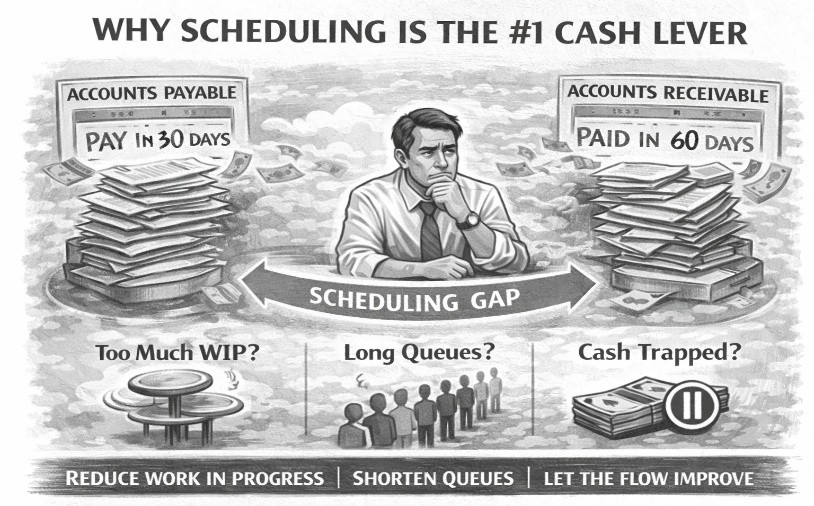
Cash Flow: The Gap Between Paying and Getting Paid
Cash flow is the third discipline in The CORE 4 framework because profit on paper is not profit in the bank. You can be profitable on every report and still run out of cash. You can have a full backlog and still miss payroll. The difference is timing — and timing is controlled by one lever most organizations ignore: scheduling.
Cash does not arrive when you finish the work. Cash arrives when the invoice clears. The gap between paying and getting paid is where cash lives or dies. Every day in that gap costs you in working capital, interest, and missed opportunity. The wider the gap, the more cash you need to operate. The narrower the gap, the faster cash cycles and the more capacity you have to grow.
This page explores why scheduling is the number one cash flow lever, how work-in-process traps cash, and what leaders can do to align daily operations to payment milestones. Cash flow depends on the profit discipline that identifies the constraint and the operating philosophy that keeps scheduling accountable.
The Scheduling Story
70 Active Projects. 4 Project Managers. Microsoft Word.
Each project manager kept a Word document with notes. Status updates. Issues. Who said what in the last meeting. Every Monday, they gathered for a weekly meeting—not for the full project scope, but for the driving department: engineering.
When asked to see the schedule, they pulled up an Excel spreadsheet—milestone rows, project columns, colors indicating status. Red meant behind schedule, but had no date. Multiple red comments on the same project meant it had been brought up as behind for multiple weeks running.
They weren't failing at scheduling. They had limited what scheduling meant.
We built a hierarchy: Project, Scope, Phase, Deliverable, Resource, Dates. What was once managed in Word documents became 150 projects, 6,000+ deliverables with owners, dates, and predecessors, and 70 customers visible in one system.
"Every project is different" is the belief that kills scheduling discipline. The variation is in the details. The process is the same.
← Back to Page Guide
Paying vs. Getting Paid
The Gap Where Cash Lives or Dies
Every business operates in a gap. You pay for materials before you sell the product. You pay employees before you invoice the customer. You pay rent, utilities, insurance—all before revenue arrives.
The wider the gap, the more cash you need to operate. You are financing the delay between expense and revenue. Every day in that gap costs you in working capital, interest, and opportunity.
The narrower the gap, the faster cash cycles. Less capital tied up. More capacity to grow. Less financial stress. Scheduling is how you control the gap.
Most companies think their gap is "normal." Projects take as long as they take. But when you map the deliverables, you suddenly see where time disappears. They weren't slow. They were blind. The gap wasn't inevitable—it was invisible.
The gap between paying and getting paid is where cash lives—or dies. The wider the gap, the more cash you need to operate.
← Back to Page Guide
In Practice
How Cash Flow Discipline Shows Up
Five leadership behaviors that close the gap between paying and getting paid.
Schedule to Constraint Pace
Don't release work faster than the constraint can process it. If the constraint handles 30 jobs per week, release 30. Work-in-process stays controlled. Lead times stay predictable.
Prioritize by $/Constraint-Hour
Not all work is equal. Schedule the jobs that generate the highest throughput per constraint hour first. A smaller job at $4,000/hour beats a larger job at $1,500/hour.
Align to Payment Milestones
Cash arrives at milestones, not at completion. Map the deliverables that trigger each payment. Schedule those deliverables first—as part of the initial plan, not an afterthought.
Make the System Visible
A schedule buried in a spreadsheet is a secret. Can the person doing the work see what's due? Can leadership see where cash is stuck? If not, you have scheduling hope, not a system.
Ask Four Daily Questions
Is the constraint fed? What's blocking? What's closest to cash? What's past due? These four questions connect daily work to cash flow at every Tier meeting.
Reality Check
Where's Your Gap?
Every industry has its version of the same problem. Cash trapped between paying and getting paid.
Manufacturing
WIP fills the floor
No one knows which jobs are closest to invoice. Materials are consumed, labor is spent, but finished goods aren't moving.
Healthcare
Claims submitted late
Reimbursement trickles in unpredictably. Services are delivered but billing paperwork sits in a queue.
Finance / Accounting
Books closed late
Reporting delays cascade through the organization. Everyone waits on reconciliation that should have been completed upstream.
Technology
Features deployed, billing unclear
Revenue recognition is delayed. The product ships but the trigger for payment isn't defined or tracked.
Construction
Work installed, draw requests wait
Documentation no one prioritized holds up payment. The work is done but the cash is still weeks away.
Government
Services delivered, paperwork queued
Reimbursement paperwork sits in someone's queue. The mission is accomplished but the funding cycle doesn't reflect it.
The CORE 4 vision: The gap is visible, measured, and actively managed—scheduling is the #1 cash lever.
Without Cash Flow
What Happens When Scheduling Is Administrative
Without scheduling discipline, the gap widens while everyone stays busy.
Philosophy Loses Teeth
Priorities shift based on who yells loudest
Without a schedule that drives decisions, projects jump the queue based on relationships, not dates. The philosophy says one thing. The daily reality says another.
Profit Gets Trapped
Throughput exists but cash never arrives
The constraint runs. Margin is generated. But work sits in process because no one scheduled to payment milestones. Profitable on paper. Cash-starved in reality.
Systems Lose Credibility
Tier meetings become status updates about the past
Without forward-looking scheduling, daily management looks backward. What happened last week. What slipped. What went wrong. Retrospective accountability that changes nothing.
The Foundation
Guiding Principles
These beliefs drive daily decisions about how cash moves through the system.
Scheduling Is Strategy
Scheduling is the #1 cash lever. Not administrative overhead.
The schedule drives the conversation, not the other way around.
If it's not in the schedule, it didn't happen. Verbal updates are noise.
The schedule is signal.
Control the Gap
Shorten the gap before chasing more sales.
Align deliverables to billing triggers before adding capacity.
AP keeps running whether work flows or not. AR only arrives when you finish and invoice.
Match WIP to Capacity
Release work at the drumbeat of the constraint.
Fewer jobs in progress means less trapped cash.
Starting work before the constraint can handle it traps cash.
Cash doesn't move faster because people work harder. It moves faster when work flows to cash.
Visibility Creates Accountability
If everyone can see Job X is blocking a $200K milestone, Job X gets attention.
When red means the same thing to everyone, conversations become productive.
Scheduling is a system, not a tool.
Key Takeaways
What to Remember
01
The gap between paying and getting paid is where cash lives—or dies. The wider the gap, the more cash you need to operate.
02
Release work at the drumbeat of the constraint. Starting work before the constraint can handle it traps cash in WIP.
03
Match WIP to constraint capacity. Fewer jobs in progress means less trapped cash and faster cash cycles.
04
Visibility creates accountability. If everyone can see Job X is blocking a $200K milestone, Job X gets attention.
05
Scheduling is a system, not a tool. The hierarchy creates structure. The views create visibility. The discipline creates trust.
Strategy Comes First. Discipline Comes Next.
Cash Flow is CORE 3 because profit on paper is not profit in the bank. The book shows you how to build the scheduling system that closes the gap between paying and getting paid.
Understanding Scheduling as a Cash Flow Lever
Most organizations treat scheduling as administrative work — something project managers maintain, not something executives own. But scheduling controls the gap between when you pay and when you get paid. When scheduling aligns to payment milestones, cash arrives predictably. When it does not, cash arrives randomly while expenses keep flowing. Cash flow problems rarely start in finance. They start in the schedule. The gap between commitment and invoice is where time disappears, and every day in that gap is cash you have spent but have not recovered.
Every job in progress represents cash already spent but not yet recovered. Materials purchased, labor hours consumed, overhead allocated — all before a single dollar comes back. The more work-in-process you carry, the more trapped cash you have. The discipline is to match WIP to constraint capacity: fewer jobs in progress means less trapped cash and faster cash cycles. Releasing work faster than the constraint can process it does not accelerate revenue. It traps capital in unfinished work that cannot be invoiced.
Sustainable cash flow requires visibility that connects daily work to financial outcomes. When everyone can see which deliverables trigger payment, those deliverables get attention. When the schedule surfaces problems before they become crises, firefighting fades and cross-functional teams align. The schedule stops being administrative overhead and becomes the operating rhythm of the business — the source of truth that connects every department to every project to cash.
The scheduling hierarchy creates structure: project, scope, phase, deliverable, resource, dates. What was once managed in Word documents and Excel spreadsheets becomes a single visible system where every stakeholder can see what is on track, what is blocked, and what triggers the next payment. The hierarchy is not the tool. The hierarchy is the thinking. The tool serves the hierarchy. When leaders build scheduling discipline around constraint pace and payment milestones, cash flow becomes predictable rather than reactive. Cash does not move faster because people work harder. Cash moves faster when work flows to completion and invoices go out.
Cash flow without philosophy creates reactive scheduling where priorities shift based on who is loudest. Cash flow without profit discipline means work sequences ignore the constraint and high-margin jobs wait while low-value work consumes capacity. And cash flow without systems means the scheduling discipline erodes the moment leadership stops watching. The CORE 4 framework treats these four disciplines as interconnected — each creates the conditions for the others to function.
Order The CORE 4 • Full framework overview • About the author • Get in touch • LinkedIn