
CORE 1 of 4
Operating Philosophy
The belief system that aligns decisions—when leadership isn't watching. Without shared belief, the other three disciplines become negotiations. Every decision escalates. Every conflict requires a meeting. Every variation triggers confusion.
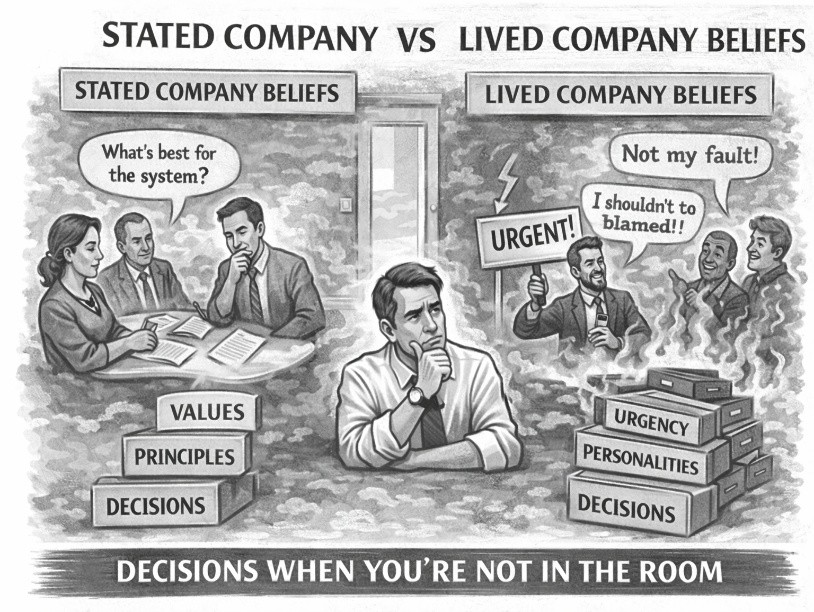
Operating Philosophy: The Foundation Every Organization Skips
Operating philosophy is the shared belief system that guides how decisions get made when leadership isn’t watching. It is the first discipline in The CORE 4 framework because without it, profit becomes a negotiation, cash flow becomes unpredictable, and systems become bureaucracy. Most organizations have mission statements, values on walls, and slide decks full of principles. But an operating philosophy isn’t what you say — it’s what people do under pressure when no one is looking.
When an operating philosophy is truly shared, 240 million strangers can drive within feet of each other at 70 miles per hour — because everyone believes in the same rules. When it isn’t shared, every conflict escalates, every priority shifts, and the best people quietly decide to leave. This page explores why this foundational discipline matters, how it breaks down, and what leaders can do to build one that actually holds.
The gap between stated philosophy and lived philosophy is the most expensive problem in any organization. It shows up as misaligned priorities, constant escalation, and decisions that change depending on who is in the room. Leaders spend their days refereeing instead of coaching, and teams learn that stated values don’t apply when the schedule slips or capacity tightens. Closing this gap is what operating philosophy is designed to do.
The Problem
Most Organizations Don't Have Operating Philosophy. They Have Posters.
They have a Mission Statement crafted during a leadership offsite, printed on posters, and hung in the lobby. They have a Vision Statement that sounds inspiring in interviews. They have "Core Values" listed on the website—Trust, Integrity, Excellence, Customer Focus—words that could apply to any company on any continent.
This is not Operating Philosophy.
Operating Philosophy is the belief system that everyone is aligned to—not because they memorized it, but because they live it. It's the answer to: How do decisions get made here when leadership isn't watching?
When the customer calls demanding faster delivery and the schedule is already full—what happens? When quality and throughput conflict—who decides? When two departments disagree on priority—what principle resolves it?
If your people don't know the answer, you don't have Operating Philosophy. You have posters.
← Back to Page Guide
The Gap
Stated Philosophy vs. Lived Philosophy
The company says "we value continuous improvement." But when an improvement is raised, it gets pushed to next year. The company says "we empower our people." But when someone makes a decision within their span of control, they get overruled. The company says "we're all in this together." But when resources conflict, each department protects its own.
The cost compounds. Rework increases because people make different decisions in similar situations. Delays multiply because every conflict requires escalation. Frustration builds because good ideas die in the queue. Turnover rises because your best people—the ones who see the problems and want to fix them—leave.
The gap between stated philosophy and lived philosophy is where your best people decide to leave.
The annual meeting sets the vision. But the daily decisions reveal the actual belief.
← Back to Page Guide
In Practice
How Operating Philosophy Shows Up
Five top-level beliefs that drive daily decisions across every function and every level.
Focus on the Constraint
The constraint determines profit. Every function exists to feed and protect it. We don't optimize silos at the expense of the system.
Schedule for Cash Flow
Scheduling isn't administration—it's the #1 cash lever. We make commitments visible and sequence work for revenue velocity.
Empower Team Members
Everyone is a CEO within their span of control. We push decisions to the lowest appropriate level because we've aligned on how decisions get made.
Daily Accountability
The system runs on rhythm, not heroics. Daily visibility. Daily action. Daily learning.
Support Escalation
Escalation is not failure—it's the system working. When someone raises an issue, the response is "How can I help?"—not silence, not blame.
Reality Check
What's Your Lived Identity?
Every industry has its version of the same gap. Values on the wall. Pressure on the floor.
Manufacturing
"Safety first" on the wall
Production pressure overrides safety stops. The stated priority disappears when the schedule slips.
Healthcare
"Patient-centered care" stated
Staffing ratios tell a different story. The mission says patients first; the budget says otherwise.
Finance / Accounting
"Accuracy and integrity" valued
Month-end pressure forces shortcuts. The standard holds until the deadline doesn't.
Technology
"Innovation culture" declared
Failure is punished. The org says take risks; the promotion cycle says play it safe.
Construction
"Quality workmanship" claimed
Corners cut when deadlines slip. Craftsmanship is valued until the liquidated damages clause kicks in.
Government
"Public service" mission
Bureaucracy blocks responsiveness. The mission is to serve; the system is designed to control.
The CORE 4 vision: Stated identity matches lived identity—at every level, under pressure, when leadership isn't watching.
Without Philosophy
What Collapse Looks Like
Without shared philosophy, the other three CORE disciplines destabilize.
Profit Destabilizes
Leaders argue about what to prioritize
One VP pushes efficiency metrics. Another pushes throughput. The constraint gets lost in the debate. Decisions are driven by politics, not principle.
Cash Flow Destabilizes
Project managers schedule to their own logic
No shared understanding of what matters. The gap between paying and getting paid widens while everyone defends their approach.
Systems Destabilize
Tier meetings become compliance theater
People attend because they have to, not because they believe. The boards fill with data no one acts on. The system becomes the obstacle.
The Foundation
Guiding Principles
These are not rules to memorize. They are beliefs to internalize. When a conflict arises, the question isn't "What does the policy say?" The question is "What do we believe?"
People
Culture beats talent. No individual is bigger than the system.
We remove waste before we remove people.
Knowledge is shared. Single points of failure are risk.
We hire for belief. We develop skill.
Performance
We measure throughput, not activity.
No department wins at the expense of the system.
We protect the constraint—even when it hurts this quarter.
Activity is motion. Throughput is progress.
Process
The process serves the business, not history.
Undocumented work is not a process.
We optimize the system, not silos.
We fix before we automate.
Growth
We stabilize before we scale.
We invest from cash, not optimism.
We don't mortgage tomorrow to pay for today.
Key Takeaways
What to Remember
01
Operating Philosophy is the foundation—without it, everything else is tools without direction.
02
When belief is shared, every person becomes a CEO within their span of control. The difference between compliance and commitment is belief.
03
The gap between stated philosophy and lived philosophy is where your best people decide to leave.
04
Without shared agreement on why we follow the rules, the rules become suggestions.
05
If the philosophy becomes negotiable when the pressure is on, it was never philosophy—it was preference.
Belief Comes First. Action Comes Next.
Operating Philosophy is CORE 1 because without shared belief, nothing else holds. The book shows you how to build it—and how leaders make it real through language, trust, direction, and daily behavior.
Understanding Operating Philosophy
Operating philosophy is the belief system that governs how decisions are made when leadership is not watching. It is not a mission statement, a set of core values on a poster, or a vision crafted during a leadership offsite. Those are declarations of identity. Operating philosophy is the lived reality — the beliefs that actually drive behavior under pressure, when the schedule slips, when capacity tightens, and when two departments disagree on priority. The gap between stated philosophy and lived philosophy is where your best people decide to leave.
When belief is shared, every person becomes a CEO within their span of control. The difference between compliance and commitment is belief. Without shared agreement on why we follow the rules, the rules become suggestions. Decisions accelerate because the framework is clear. Conflicts decrease because the philosophy resolves them before they escalate. Trust deepens because people know what to expect from each other. Heroes become unnecessary because the system handles variation.
Consider how 240 million licensed drivers merge at highway speeds within feet of each other every day. It works not because of signs, lane markings, or police — it works because of shared belief, a collective agreement to operate in a way that serves everyone. Before any road was paved, before any sign was posted, there had to be a collective agreement. The belief came first. The system followed. The same is true for your business. Before the standard work documents, before the visual boards, before the daily huddles — there must be shared belief about how we operate.
When philosophy is shared, escalation becomes support rather than failure. Leaders stop debating how to operate and start executing with clarity. Accountability becomes natural because everyone knows what good looks like. Improvement becomes continuous because ideas do not wait for next year. The standard is shared, not negotiated. If the philosophy becomes negotiable when the pressure is on, it was never philosophy — it was preference. The operating philosophy is not a document on the wall. It is the lived belief that drives every decision, at every level, in every moment. No heroes wanted. No firefighters. Just shared belief that makes the right decision obvious — whether leadership is watching or not.
Operating philosophy without profit discipline creates noble failure — beautiful values that cannot be funded. Philosophy without cash flow management means alignment exists but money never arrives predictably. And philosophy without systems fades the moment leadership stops reinforcing it. The CORE 4 framework treats these four disciplines as interconnected — each creates the conditions for the others to function.
Order The CORE 4 • Full framework overview • About the author • Get in touch • LinkedIn