
CORE 2 of 4
Profit
The throughput discipline that generates margin at the constraint. Revenue misleads. Throughput per constraint hour reveals the truth. Without constraint focus, every department optimizes locally while the system bleeds profit.
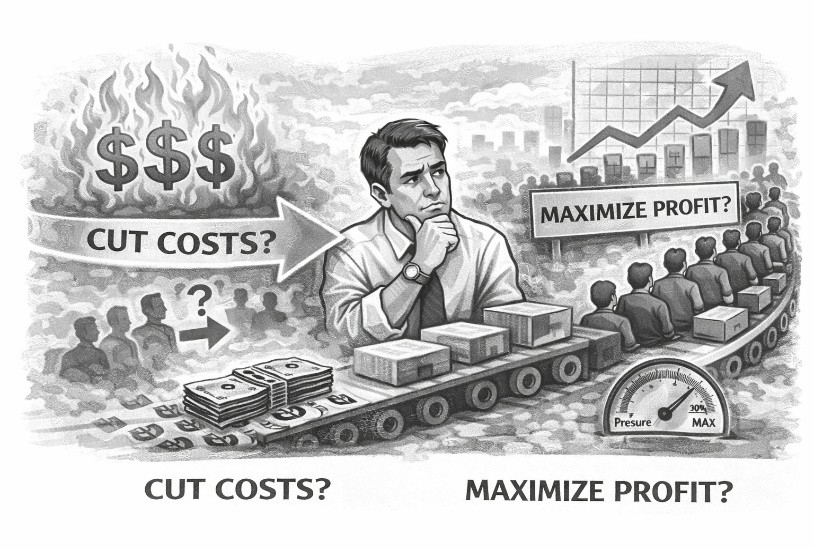
Profit: Why Revenue Misleads and Where Margin Actually Lives
Profit is the second discipline in The CORE 4 framework because you must generate margin before you can manage cash. Most organizations chase revenue, celebrate departmental efficiency, and call it success. But efficient departments don’t guarantee margin. Profit is made at one place in your operation — the constraint — and every minute it waits is throughput lost forever.
Throughput per constraint hour is the number that reveals the truth. A $50K job that moves twice as fast generates more margin than a $100K job that crawls through the system. Traditional accounting says chase the big revenue. Throughput accounting says chase the dollars per constraint hour. The size of the job doesn’t determine profitability — the speed at which it flows through your constraint does.
This page explores why the constraint is your profit clock, how local optimization destroys system performance, and what leaders must do differently to protect throughput every day. Without the operating philosophy that says “we focus on the constraint,” local optimization always wins — and profit leaks while everyone stays busy.
The Efficiency Trap
Efficient Departments Don't Guarantee Profit
Traditional thinking celebrates efficient departments. Purchasing buys in bulk—efficient purchasing, trapped cash. Production runs large batches—efficient production, extended lead times. Each department hits their metrics. Leadership calls it success.
But the system loses.
Profit is not made in efficient departments. It is made when the constraint runs. The shift is cultural. It requires leaders to stop celebrating departmental efficiency and start celebrating system velocity.
One production line appeared to run at capacity—every station busy, every rack full. But 80 minutes per changeover was building WIP that never became finished product. Non-constraint stations were actually taking longer than the constraint. The batch system made it invisible.
"At capacity" usually means "at the capacity we've accepted." WIP that doesn't become finished goods is waste disguised as progress.
← Back to Page Guide
Revenue vs. Throughput
Revenue Misleads. Throughput Reveals the Truth.
Traditional accounting says chase the big revenue. Throughput accounting says chase the dollars per constraint hour. The size of the job doesn't determine profitability. The speed at which it flows through the constraint does.
Throughput = Revenue − Truly Variable Costs. That's the cash contribution from each unit passing through the constraint. Not revenue. Not margin. The money generated when the constraint produces.
Truly variable costs are the costs that change with each unit—raw materials, direct labor at piece rate, commissions. Everything else is operating expense. It doesn't change whether you produce one unit or one thousand.
A $50K job that moves twice as fast generates more profit than a $100K job. Revenue misleads. Throughput per constraint hour reveals the truth.
Every 5% drop in constraint utilization costs real dollars. If your constraint generates $400 per hour and runs 2,000 hours per year, maximum throughput is $800,000. A 5% utilization drop costs $40,000—not in cost, but in revenue that never happens, cash that never arrives, profit that never exists.
← Back to Page Guide
In Practice
How Constraint Discipline Shows Up
Five leadership behaviors that protect the profit clock every day.
Identify the Constraint
Walk your workflow from start to cash. Where does work pile up? Where do queues build? That's where you start looking. You can't protect what you haven't named.
Surround with Faster Processes
Every surrounding process must have a cycle time less than the constraint. If upstream is slower, the constraint starves. If downstream is slower, work piles up and cash gets trapped.
Feed the Constraint
The constraint never waits. Staged materials, completed case files, tested code—whatever the constraint needs should be ready before it asks. Build the buffer. Monitor it daily.
Protect from Time Thieves
Changeovers, waiting for decisions, meetings, breakdowns, searching, rework—each steals a percentage of utilization. Track them. Attack the biggest losses first.
Exploit Before You Elevate
Before buying capacity: Improve. Divide. Share. Add resources. Then—and only then—open the checkbook. Most organizations skip straight to buying equipment when smarter options exist.
Reality Check
Where's Your Constraint?
Every industry has its version of the same problem. Local optimization looks productive while the constraint starves.
Manufacturing
Every department optimizes locally
The bottleneck starves while each department hits their metrics. Utilization reports look great. The system bleeds throughput.
Healthcare
All departments run at 95% utilization
The OR sits waiting for beds. Every unit is efficient. The patient waits.
Finance / Accounting
Every team processes transactions
Reconciliation backs up at month-end. Everyone is busy upstream. The constraint drowns downstream.
Technology
All teams sprint at full speed
Deployment backs up in QA. Features ship faster than they can be tested. Velocity is celebrated while quality erodes.
Construction
Every trade pushes their scope
The critical path slips. Each trade optimizes their own schedule. The project finish date moves.
Government
Every unit hits activity metrics
Approvals stack up at one desk. Everyone downstream is productive. One bottleneck gates everything.
The CORE 4 vision: The constraint is named, protected, and visible—everything else exists to serve it.
Without Profit
What Happens When Constraint Discipline Is Missing
Without constraint focus, the other three disciplines lose their center of gravity.
Philosophy Loses Its Target
Belief without a profit engine is noble failure
Beautiful values and genuine commitment to doing things right. Culture scores are high. But the constraint isn't managed. The business slowly starves while everyone agrees on principles that can't be funded.
Cash Flow Becomes Random
Revenue arrives but margin disappears
Work flows through the system in whatever order seems logical. High-margin jobs wait while low-value work consumes constraint capacity. Cash arrives randomly instead of predictably.
Systems Track the Wrong Things
Activity metrics replace throughput metrics
Every department reports "on track." Utilization numbers look healthy. But no one is measuring whether the constraint is running. The system manages activity, not profit.
The Foundation
Guiding Principles
These beliefs drive daily decisions about where profit is made and how leaders protect it.
Constraint First
The constraint determines profit. Everything else is secondary.
An hour lost at the constraint is an hour lost to the entire system.
An hour saved at a non-constraint is worthless.
Constraint utilization is a financial metric, not an operational one.
Throughput Over Revenue
Revenue misleads. Throughput per constraint hour reveals the truth.
The size of the job doesn't determine profitability.
Prioritize by $/constraint-hour, not by dollar value.
Constraint protection is daily discipline, not quarterly review.
System Over Silos
Efficient departments don't guarantee profit.
No department wins at the expense of the constraint.
Flow beats utilization. Velocity beats efficiency.
The question isn't "Is every department efficient?" It's "Is the constraint running?"
Exploit Before Elevate
Improve. Divide. Share. Add resources. Then open the checkbook.
Zero defects to the constraint. Upstream quality is constraint protection.
Know your time thieves. Attack the biggest losses first.
Key Takeaways
What to Remember
01
Revenue misleads. Throughput per constraint hour reveals the truth. A $50K job that moves twice as fast generates more margin than a $100K job.
02
Without the belief that the constraint determines profit, local optimization always wins.
03
If constraint utilization is below 85%, that's your biggest opportunity—not sales, not cost-cutting.
04
Every minute the constraint waits is profit lost forever. You can't make up constraint time with overtime at non-constraints.
05
The question isn't "Is every department efficient?" The question is "Is the constraint running?"
Insight Comes First. Discipline Comes Next.
Profit is CORE 2 because you must know where margin lives before you can protect it. The book shows you how to identify the constraint, lead with throughput, and make every decision serve the profit clock.
Understanding Constraint-Based Profit
A constraint is the single limiting factor that governs the pace of your entire system. It is not the same as a bottleneck — bottlenecks are temporary capacity issues that can be fixed, while the constraint is the pacemaker that remains after all improvement considerations. Your constraint is your profit clock: every hour it runs, throughput is generated. Every hour it waits for materials, decisions, or upstream delays, that throughput is gone forever. If your constraint generates $500 per hour and sits idle for one hour, that is $500 lost — not delayed, gone.
Traditional thinking celebrates efficient departments where every team hits their metrics. But purchasing buying in bulk traps cash. Production running large batches extends lead times. Each department wins while the system loses. Margin is not made in efficient departments — it is made when the constraint runs. The shift requires leaders to stop celebrating departmental efficiency and start celebrating system velocity. The question is not whether every department is efficient. The question is whether the constraint is running.
Profit without philosophy creates mercenary culture — the organization makes money but no one agrees on how or why. Throughput without cash flow discipline means numbers on paper never reach the bank. And constraint discipline without systems depends on heroes who eventually burn out and leave, taking tribal knowledge with them.
Leaders who understand constraint thinking see their operation differently. Every role becomes a doctor — someone with a unique capability who adds value that no one else in the process can add. The constraint is the most critical doctor in your system, and it deserves the same treatment: everything staged, every question answered, every decision pre-made. When you walk your operation and ask “Is this person being treated like a doctor?” the answer reveals where your system is serving people and where people are serving a broken system. Become the product. Follow it through the process from start to cash. Where do you wait? That is a queue. Where do you get touched but not transformed? That is waste. Where do you sit while people discuss what to do with you? That is a decision gap.
The CORE 4 framework treats these four disciplines as interconnected — each creates the conditions for the others to function. Operating Philosophy (CORE 1) is the belief system that makes constraint thinking possible. Cash Flow (CORE 3) converts margin to money through scheduling. Sustainable Growth (CORE 4) builds the systems that scale without depending on heroes.
Order The CORE 4 • Full framework overview • About the author • Get in touch • LinkedIn